
Shifting freight from road to rail is one of the most visible levers for lower transport emissions. It is also one of the most frequently misjudged. On some lanes rail saves cost and CO₂e at the same time; on others it adds handling, time and risk without a real benefit.
This guide explains how logistics teams compare transport modes properly – lane by lane, door to door – and how to turn the comparison into a decision management can follow.
Why rail-vs-road comparisons often go wrong
The most common mistake is comparing main-run rates only. A rail rate per tonne-kilometre can look attractive, but freight rarely starts and ends at a rail terminal. Pre-carriage by truck, terminal handling and on-carriage to the customer are part of the real cost – and of the real emissions.
Other typical blind spots: longer and less flexible transit times, minimum volumes or fixed departure schedules, and the effect on warehouse operations when shipments arrive in larger, less frequent batches.
Compare door to door, not terminal to terminal
For each lane, compare the full chain of both options:
- Cost: pre-carriage, terminal handling, main run and on-carriage – using real freight rates where you have them, since tolls and surcharges are already included.
- Lead time and reliability: door-to-door transit time and how often it is met.
- CO₂e: emissions of every leg, not just the main run.
- Capacity and frequency: available slots, departure days and minimum volumes.
- Service level: whether customers in the region are still served within the target time.
Where rail typically fits – and where it does not
There is no universal threshold, but some patterns hold across many networks. Rail tends to fit long distances, steady and predictable volumes, heavy or bulky goods, and sites with a siding or a terminal nearby. Road keeps the advantage for short distances, small and irregular shipments, time-critical deliveries and customers far from any terminal.
Instead of debating these patterns in general, test them on your own lanes. The answer is usually a mix: a handful of lanes where rail clearly wins, and many where it does not.
Think in networks, not single lanes
Changing the transport mode on one lane affects the rest of the network. Rail may make it attractive to consolidate volume in fewer warehouses, to serve a region from a different site, or to change delivery frequencies. Looking at one lane at a time misses these effects.
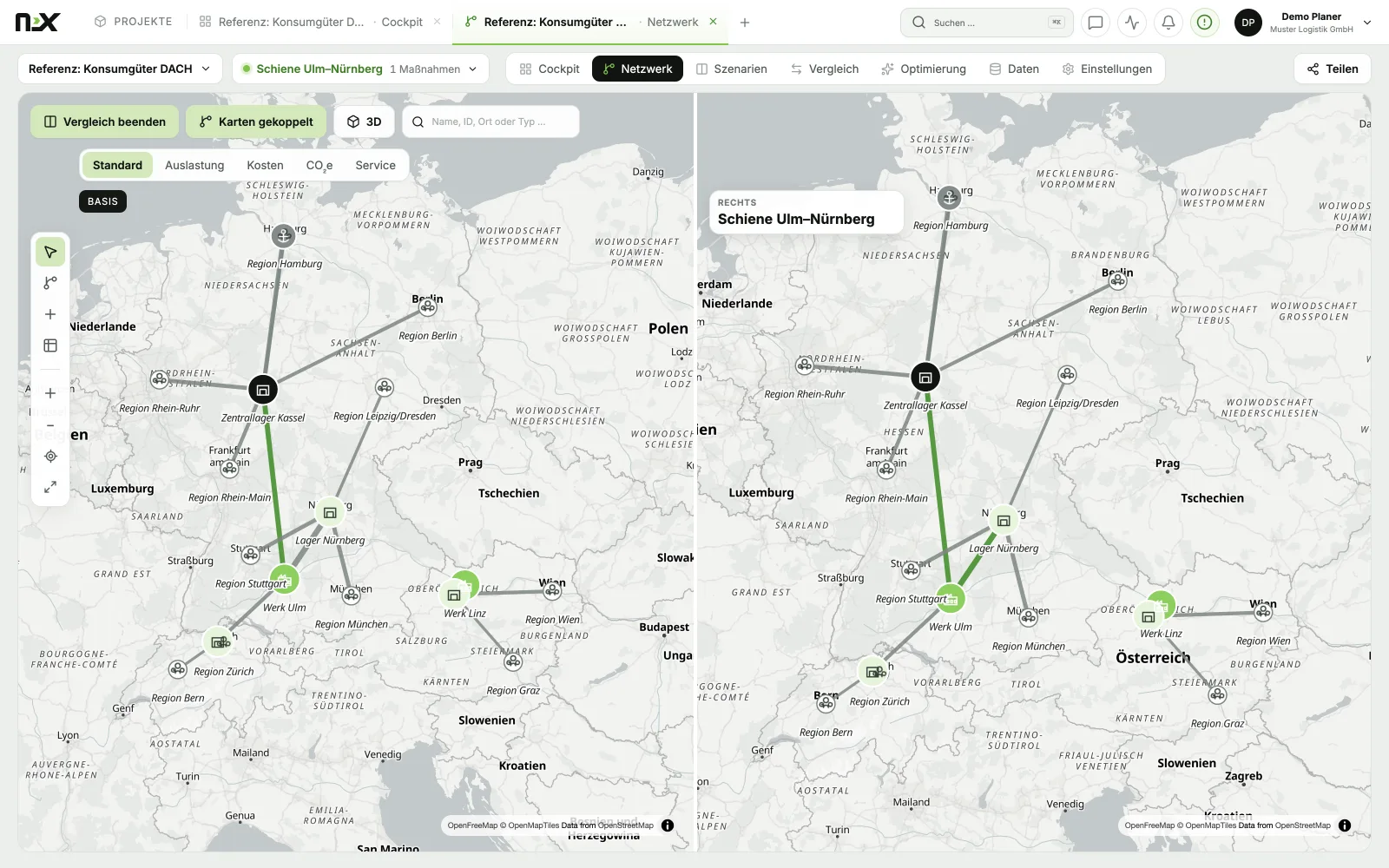
That is why a modal shift is best evaluated in a network model: the rail option becomes a scenario on top of the unchanged baseline, and the model recalculates cost, emissions, utilisation and service level for the whole network. Read more in our guide to warehouse location planning.
Measure CO₂e consistently
Emission figures are only useful if they are comparable. Use the same method, the same emission factors and the same system boundaries for the baseline and every scenario, and include all legs of the transport chain. International standards such as ISO 14083 describe how to quantify greenhouse gas emissions of transport chains; whichever method you use, document it with the results.
Keep in mind that network figures are planning values. They are precise enough to compare alternatives and to support a decision, but they do not replace the carrier’s actual emission reporting after the shift.
Decide with scenarios and sensitivities
A robust recommendation survives changing conditions. Calculate the rail scenario against the baseline, then test sensitivities such as higher or lower diesel prices and volumes 20 % above or below plan. If rail still wins on a lane under these conditions, it is a strong candidate. If the advantage disappears, keep the lane on the road or run a pilot first.
Finally, put the results into a decision paper: the lanes recommended for rail, the expected change in cost, CO₂e and service level, the assumptions behind the figures, and the next steps with carriers.
Frequently asked questions
Is rail freight always cheaper over long distances?
Not always. Pre-carriage, terminal handling and on-carriage can outweigh a cheaper main run. Only a door-to-door comparison per lane shows whether rail is cheaper on that lane.
How do I get CO₂e figures per transport mode?
Calculate emissions per leg from volumes, distances and transport mode using one consistent method, for example following ISO 14083, and apply the same method to the baseline and all scenarios.
What volume makes rail worthwhile?
There is no universal threshold. Rail works best with steady, predictable volumes on long lanes near a terminal or siding. Testing your own lanes in a scenario gives a far better answer than a rule of thumb.
Do tolls matter in a rail vs. road comparison?
Yes. Tolls are part of road transport cost. Using real freight rates or invoices captures them automatically, which is more accurate than adding a flat toll assumption.
Related reading
Rail instead of road?
Compare transport modes per lane by cost, CO₂e and service level – on top of your real network.