
For a small business, cash flow is not an accounting topic – it decides whether the next hire, the next machine or the next quiet month is affordable. Yet the way from quote to cash is often full of delays: quotes wait for a phone call, invoices are written at the end of the month, and reminders go out when someone remembers.
This guide walks through the quote-to-cash process step by step and shows where small teams can save time and get paid faster.
Where cash gets stuck
- Quotes are sent as PDFs and accepted by email or phone – or not at all, and nobody follows up.
- Invoices are written days or weeks after delivery, often by copying from the quote.
- Unpaid invoices are tracked in someone’s head.
- Every VAT return starts with a search for receipts.
Step 1: quotes clients accept online
Build quotes from a catalogue of services and products with fixed prices, so every quote is consistent and fast to create. Instead of waiting for a signed PDF, send a link: the client accepts the quote online with name and signature. Acceptance is documented, and the next step can start immediately – for example by creating the project automatically.
Step 2: invoicing in one click
An accepted quote should become an invoice without retyping. The same applies to tracked time and to subscriptions or retainers, which can be billed automatically each period. Sequential number ranges, credit notes and PDFs on your own letterhead keep the paperwork clean. The shorter the gap between delivery and invoice, the earlier the money arrives.
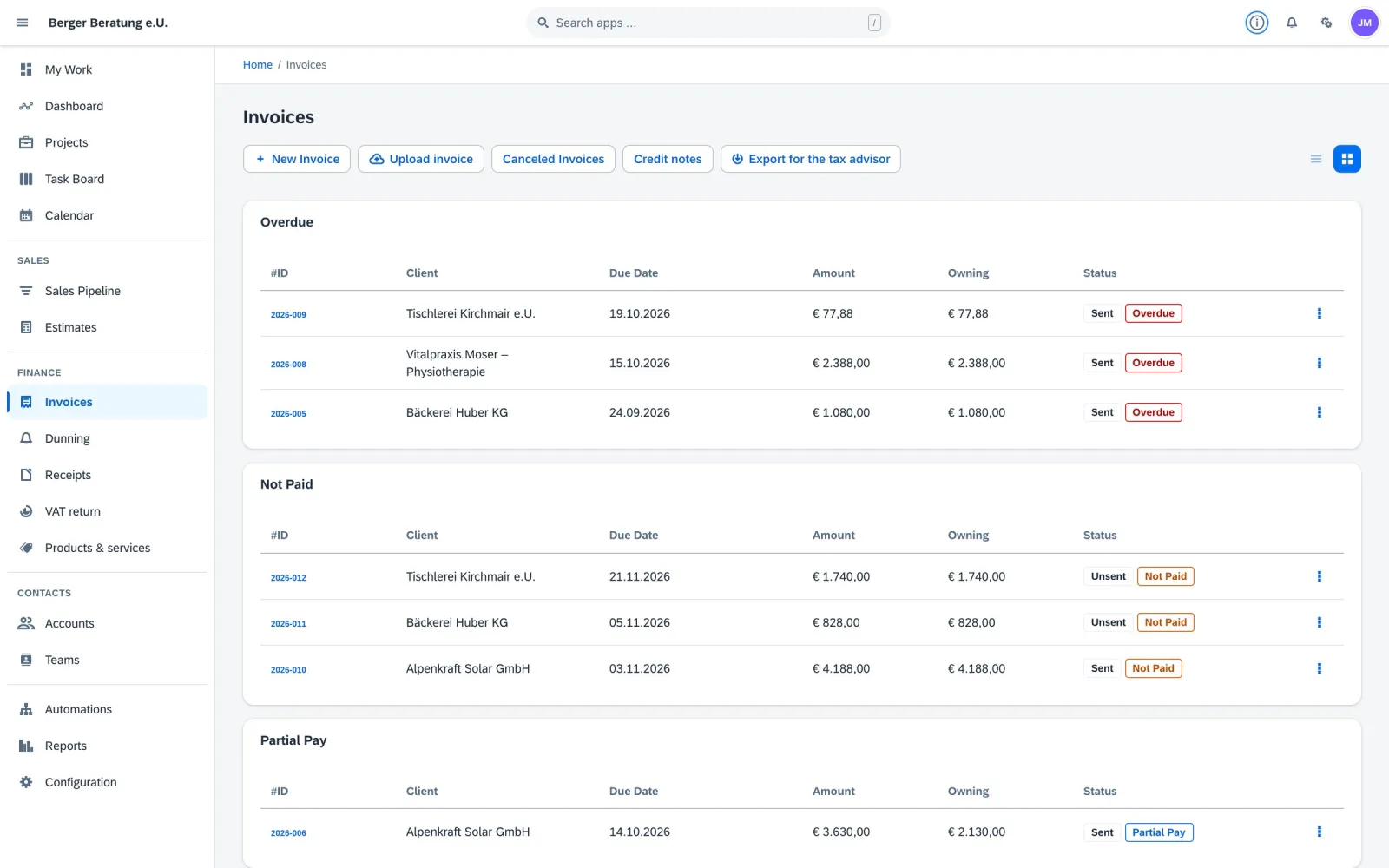
Step 3: dunning on autopilot
Most late payments are not bad intent – the invoice was simply forgotten. A friendly, timely reminder solves most cases. The key is consistency: define a schedule once, for example a payment reminder a few days after the due date, followed by a first and a second notice at fixed intervals, and let the system send them. Overdue, unpaid and partially paid invoices are always visible, sorted by status.
Step 4: receipts and the VAT return
Upload receipts when they arrive, not at the end of the quarter. With tax cases set correctly on every invoice – such as reverse charge for B2B services to other EU countries, or VAT-exempt training – the system can prepare a VAT return preview. In Austria, a preview based on the U30 form, monthly or quarterly, gives your tax advisor clean figures and makes filing via FinanzOnline faster. Switching between cash basis and accrual basis, with credit notes included automatically, avoids manual corrections.
A VAT preview supports your tax advisor; it does not replace tax advice. Agree with your advisor which figures and exports they need.
Step 5: automations that close the loop
Small automations add up: quote accepted → create project; invoice due → send reminder; payment received → send a thank-you email. Each one removes a manual step and a chance to forget. For a structured approach, see workflow automation: where to start.
What to measure
- Average days to payment – the most direct measure of your quote-to-cash speed.
- Receivables aging: how much is overdue, and for how long.
- Quote win rate and the time from quote to acceptance.
- Cash forecast: expected incoming payments for the coming weeks.
Looking for the system to run this in? Our guide to ERP for consulting firms and agencies lists what to look for.
Frequently asked questions
What is quote to cash?
Quote to cash is the process from the first quote to the payment received: quote, acceptance, delivery, invoicing, payment and dunning. Shortening it improves cash flow directly.
How many payment reminders should a small business send?
A common practice is a friendly payment reminder shortly after the due date, followed by a first and second notice at fixed intervals. What matters most is a consistent schedule that runs automatically.
What is reverse charge on an invoice?
With reverse charge, the customer rather than the supplier owes the VAT – common for B2B services between EU countries. The invoice must show that reverse charge applies; the system should handle this as a tax case.
Does a VAT return preview replace my tax advisor?
No. A VAT return preview, for example based on the Austrian U30 form, gives your tax advisor clean figures and saves time, but the responsibility for filing stays with you and your advisor.
Related reading
Get paid faster.
Online quote acceptance, automatic dunning and a VAT return preview in one system – free for 30 days.