
The Confidential Information Memorandum (CIM) introduces a company to potential buyers: its business, market, customers, organisation and financials. A good CIM speeds up the process and supports the price. Writing it, however, takes many hours of reading, structuring and formulating – often under time pressure.
AI can take over much of the drafting. Used carelessly, it can also introduce errors into the one document buyers rely on most. This guide shows how M&A advisors use AI for the CIM with sources, quality checks and a clear review process.
Why the CIM takes so long
Most of the content already exists – in annual accounts, management presentations, product sheets, customer lists and the company website. The work lies in reading it, extracting what matters, reconciling contradictions and turning it into a consistent narrative. In a sample calculation for a sell-side mandate, the CIM draft alone accounts for around 25 hours of work.
A CIM typically covers an executive summary, the company and its history, products and services, market and competition, customers and sales, organisation and management, financials and the transaction itself. Each chapter draws on different documents.
The risks of drafting with a generic AI chat
- Invented facts: language models can produce plausible statements that no document supports.
- No sources: without references, every sentence has to be checked against the original documents again.
- Confidentiality: uploading data-room documents to a consumer chat tool raises questions about where the data goes and whether it is used for training.
- No trail: nobody can tell later which version was reviewed and released.
A better approach: data room in, sourced draft out
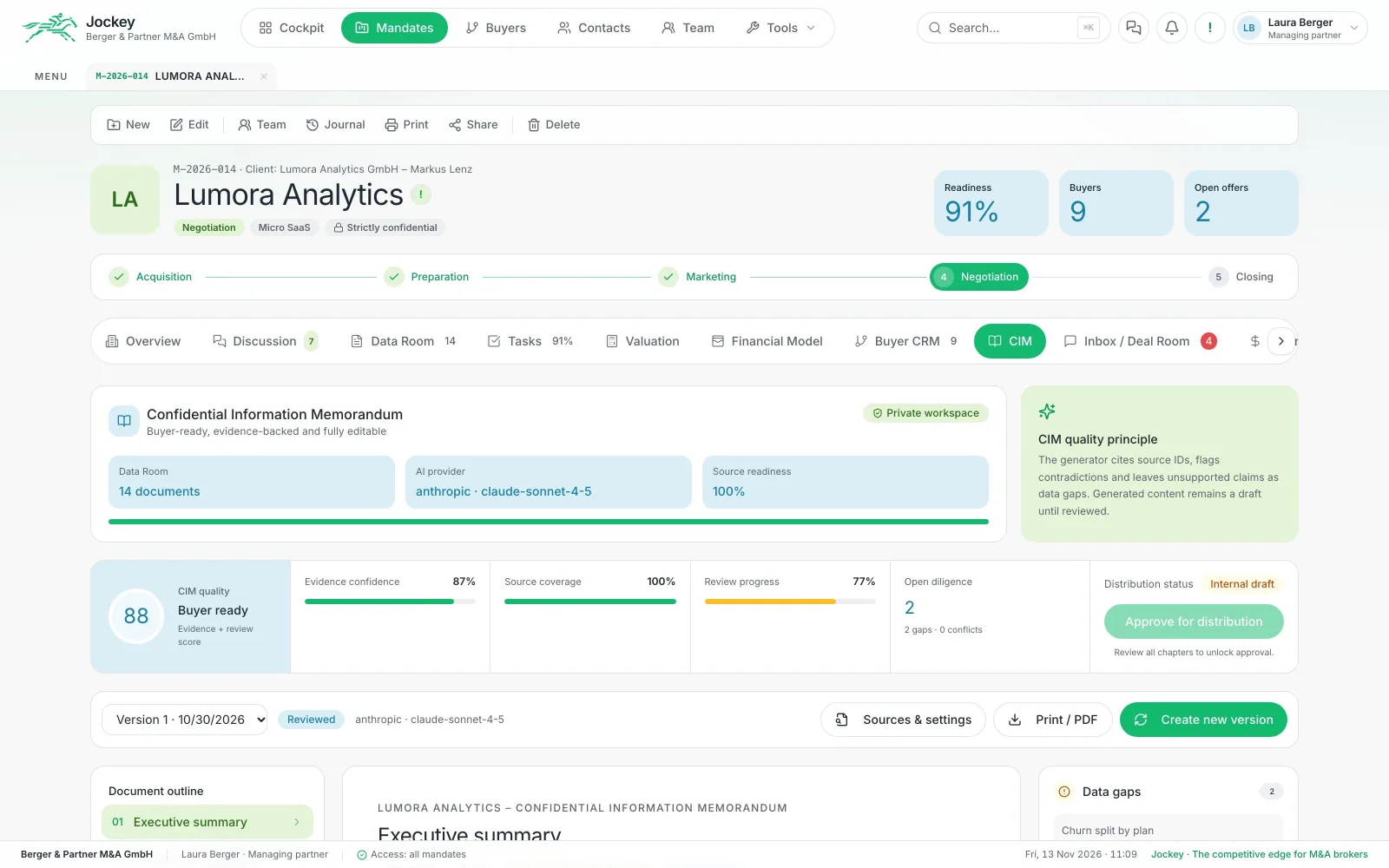
A reliable CIM generator works from the mandate’s own data room. You select the documents it should use; it reads them and adds public sources such as the company website, product pages and news – each with source and date. Every statement in the draft is backed by a source, so reviewers can check it with one click instead of searching through the data room.
Quality control before anything goes out
Drafting is only half of the job. Good tooling also measures the quality of the draft:
- Evidence rate: how many statements are backed by a source.
- Data gaps: chapters where the data room does not provide enough information.
- Contradictions: figures or statements that differ between documents.
- Quality score: an overall indicator to decide whether the draft is ready for review.
The review then happens chapter by chapter. Only when every chapter has been checked is the CIM released for distribution to buyers.
Confidentiality and control over the AI
Treat the AI provider like any other processor of confidential data. Practical safeguards include choosing the provider yourself – for example OpenAI, Anthropic Claude or Mistral – using your own API key, making sure requests are not released for model training, limiting access to the mandate team, and logging every step in the mandate journal. Our guide to data governance for reliable AI explains the broader principles.
The role of the team
AI changes who does what, not who is responsible. Analysts select the documents and check data gaps, deal managers review the chapters, and partners decide on release. The time saved goes where it matters most: into the equity story, the buyer approach and the negotiation.
The same approach works beyond the CIM. AI buyer research builds a qualified longlist of strategics, private equity funds and family offices with fit and source for every match, and the teaser and NDA drafts follow from the same data. Read more in our checklist for M&A deal management software.
Frequently asked questions
Can AI write a complete CIM?
AI can draft most of a CIM from the data room and public sources. The equity story, final figures and release remain the responsibility of the deal team, who review the draft chapter by chapter.
How do we make sure the AI does not invent facts?
Use a tool that backs every statement with a source from the data room or public sources, measures the evidence rate, flags data gaps and contradictions, and requires a human review before release.
Is our mandate data used to train AI models?
It should not be. Choose a setup where you select the AI provider, use your own API key and requests are not released for training – and limit access to the mandate team.
How much time does AI save on a CIM?
It depends on the mandate and the quality of the data room. In a sample calculation, the CIM draft accounts for around 25 hours per mandate – a large share of which AI drafting with sources can take over.
Related reading
See the CIM generator live.
In a 30-minute demo we show Jockey on your own sell-side process – including AI buyer research and the CIM with sources.